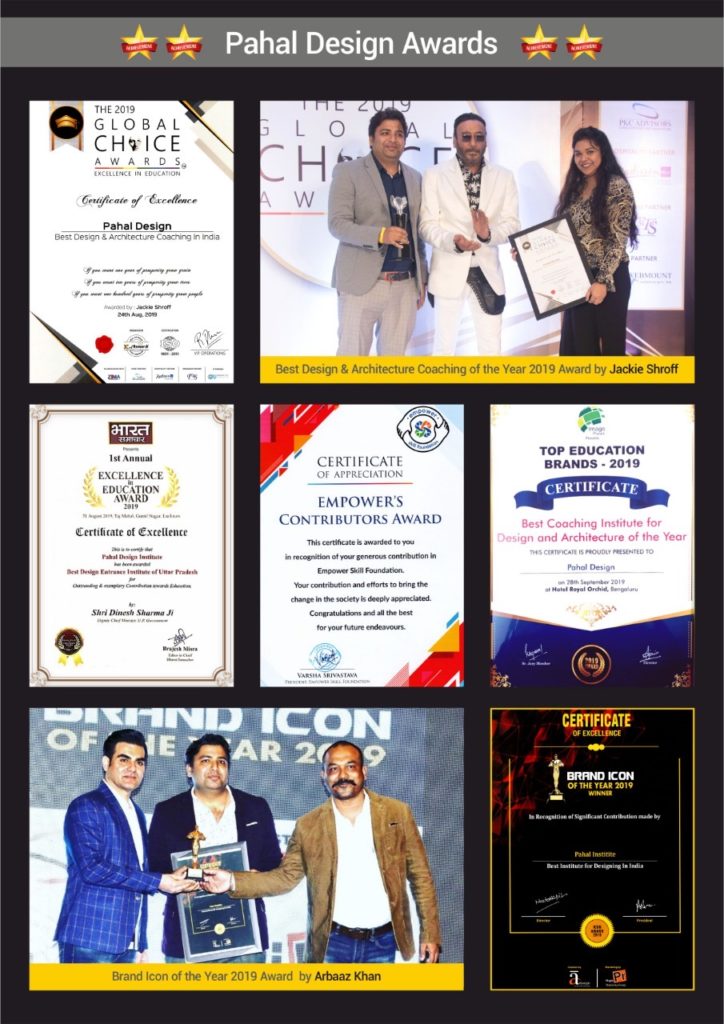
Pahal Design has been preparing students for entrance tests since 1999. Every year, Pahal Design mentors over 5,000 students and helps them secure a seat in to design Architecture and Fine arts institutes in India as well as across the world. Pahal Design highly experienced and expert faculty from reputed institutes such as NID, NIFT, IDC Mumbai, SPA well researched and updated study material, mock test, Doubt clearing sessions and online resources make Pahal Design the first choice of Design and Architecture aspirants. Finally, our coaching and guidance programs are so superior that they come with a guarantee!

Conveniently located Opposite Himalaya Mall, Pahal Design Ahmedabad prepares students for Design entrance exams such as NID, NIFT, UCEED and CEED, Architecture exam NATA JEE Arch and Fine Arts colleges like MSU, J J College, BHU, DCA and many more.

Pahal Design started it’s 31st Centre in Ahmedabad and 1st Centre in Gujrat. After 21 years of Academic excellence in Design Architecture and Fine Arts now Pahal Design will impart the quality education in Ahmedabad also by creating rank holder in NID, NIFT, NATA, JEE Arch, CEED and UCEED Exams.

Pahal Design Classroom Coaching Program Includes:
1. NID B.Des Entrance Exam Coaching
2. NID M.Des Entrance Exam Coaching
3. NIFT B.Des Entrance Exam Coaching
4. NIFT M.Des Entrance Exam Coaching
5. NIFT MFM Entrance Exam Coaching
6. NIFT B.Ftech Entrance Exam Coaching
7. NATA Entrance Exam Coaching
8. Jee Arch Entrance Exam Coaching
9. UCEED Entrance Exam Coaching
10.CEED Entrance Exam Coaching
11. CEPT Entrance Exam Coaching
12. MSU Entrance Exam Coaching
13. J J College Entrance Exam Coaching

ABOUT AHMEDABAD

Ahmedabad has emerged as an important economic and industrial hub in India. It is the second-largest producer of cotton in India, and its stock exchange is the country’s second oldest. Cricket is a popular sport in Ahmedabad, which houses the 54,000-seat Sardar Patel Stadium. The effects of liberalisation of the Indian economy have energised the city’s economy towards tertiary sector activities such as commerce, communication and construction.
Ahmedabad is considered as an important hub for higher education in India and its history is stretching back to Pre-Independence era. Ahmedabad had a literacy rate of 79.89% in 2001 which rose to 89.62 percent in 2011. As of 2011, literacy rate among male and female were 93.96 and 84.81 percent respectively. In 2012, The Times of India chose Ahmedabad as India’s best city to live in. Ahmedabad has been selected as one of the hundred Indian cities to be developed as a smart city under Government of India’s flagship Smart Cities Mission. In 2010 Ahmedabad was ranked third in Forbes’s list of fastest growing cities of the decade.
The Gujarati community is largely known for its hospitality and for being shrewd businessmen. Ahmedabad is a big industrial city long reputed for its textile industry, and today more so for its chemical, petroleum, international trade & IT industries. The city has been put on world map by its Islamic architecture like shaking towers or Zulte Minar , Sidi saiyed jali, Sarkhej roza, Kankaria lake originally known as a Hauze kutub aazam mauzam’s tomb , Jama masjid, tombs of sultan Ahmed shah and his queen, and also a lots of beautiful heritage mosques, also famous for world famous ISRO, PRL and institutions like Indian Institute of Management – Ahmedabad, Indian Institute of Technology Gandhinagar, National Institute of Design, Pandit Deendayal Petroleum University (PDPU), Dhirubhai Ambani Institute of Information & Communication Technology, IHM, MICA, EDI, Nirma University, Gujarat Law society, Swaminarayan Gurukul, CEPT (Centre for Environmental Planning and Technology) University, NIFT and a few others. The place has become a landmark for good education practices.
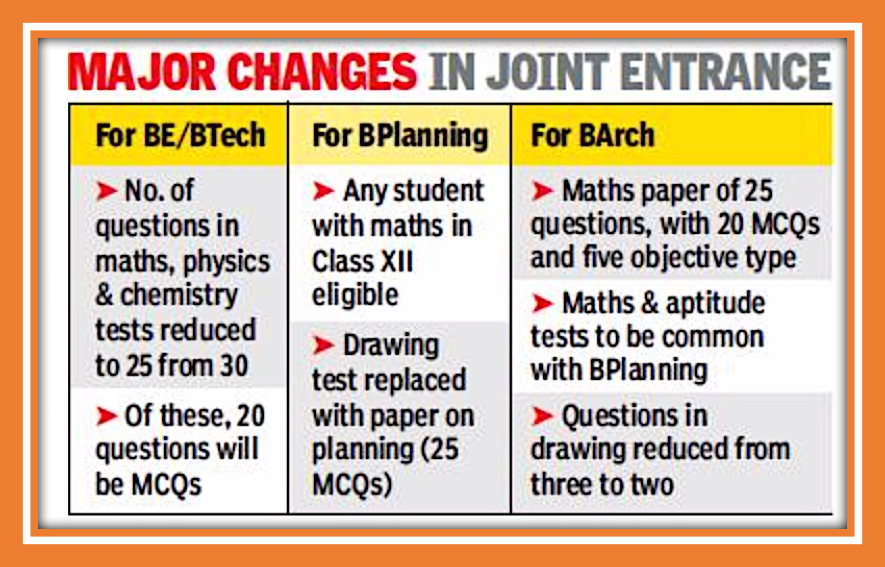
For the first time in 20 years, all candidates taking the JEE will face less number of questions in physics, chemistry, mathematics as well as engineering drawing (for architecture aspirants). JEE is the entrance exam for all centrally funded technical institutes and colleges. It is also the eligibility exam for IIT JEE.

For the Bachelor of Planning course, only students who had physics, chemistry and mathematics in Class XII were so far eligible. Now, the criteria have been narrowed down to just mathematics in Class XII. Also, those seeking to enter the stream will not need to take the drawing test, which will be only for architecture aspirants.

Registration for JEE (Main) to begin from today

These changes were approved by the ministry of human resource development on Monday. The registration for JEE (Main) will commence from Tuesday. For the first time in 15 years of JEE, the number of questions have been reduced and the question typology changed. Earlier, engineering (BE/BTech) aspirants used to appear for three papers — mathematics, physics and chemistry — each comprising 30 multiple choice questions. From now on, each paper will have 25 questions. Of these, 20 will be MCQs and five “questions with answers as numerical value, with equal weightage to mathematics, physics and chemistry”.

For BArch, the mathematics paper will comprise 25 questions, with 20 MCQs and five objective-type. Questions in the drawing paper have been reduced from three to two. There will be an aptitude test of 50 marks in the MCQ format.

Mathematics and aptitude papers will remain common to B Planning and BArch aspirants. However, unlike previous years, there will be no drawing paper for B Planning aspirants and candidates instead will have to take a paper of 25 MCQs on planning.

“There are a number of changes introduced by the National Testing Agency for the JEE (main) to be held in January and April 2020. The details will be uploaded on Tuesday on the official website of NTA,” said Vineet Joshi, director-general, NTA. The first edition of JEE (Main) 2020 will be conducted from January 6 to January 11 and the second JEE (Main) will be held from April 3 to April 9. Registration for the January exam starts on Tuesday.

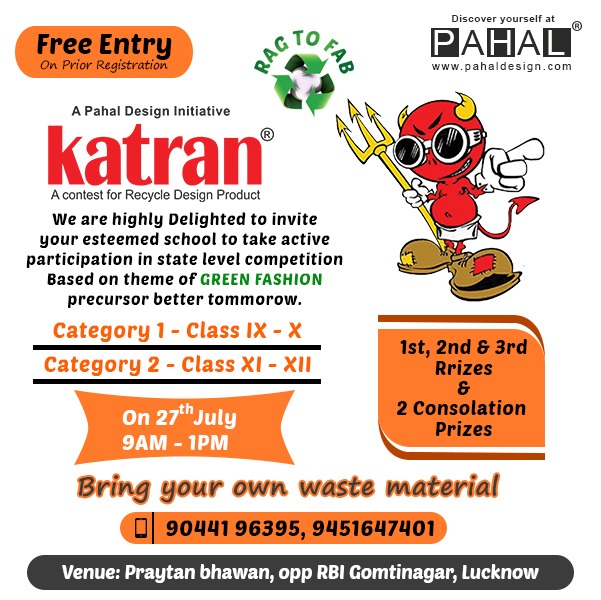
The purpose of which is to educate the children and the society as to how a material termed as waste can be brought to productive use. This event is conducted across the cities Delhi, Pune, Bangalore, Patna, Ranchi, Lucknow, Varanasi, Kanpur, Dehradun, Ghaziabad, Bhopal and Ludhiana.

“Katran” is an opportunity to promote and create awareness and to introduce green fashion in not only our state but in the whole country

It gives me immense pleasure to invite your prestigious school for KATRAN 2019

  1. CATEGORY – 1 = CLASS (IX – X) – 1st, 2ndand 3rdPrizes and 2 consolation Prizes
  2. CATEGORY – 2 = CLASS (XI – XII) – 1st, 2ndand 3rdPrizes and 2 consolation Prizes

*Consolation Prizes if number of students are more than 100 in a Category

*Participation Certificate will be given to every Participants.

As you understand it’s the stage where our young generation needs to taught and guided to judicially use our resources and KATRAN is a platform to learn and show.

  • How do I make useful household things from waste?
  • Creative ideas to get best out of waste.
  • Material Manipulation to create and get what you want
  • Encourage to use waste rather than throwing away, helps in waste management
  • Promote and create awareness and introduce green Fashion.

The Rule of the event is

  • Participation strictly on Registration on the format as provided
  • Not More than 5 students in a group

The Student can choose from the following sectors:

  1. Household items
  2. Product that can be used in School
  3. Wearable accessories
  4. souvenirs or Gift items
  5. Industrial use or Social Usage.
  • The contest will be strictly on spot, any deviation will lead to disqualification.
  • The marks will be out of 100
  • The final designed product will be evaluated by a panel of independent judges from design field.
  • The markings will be allotted as per the below criteria
  1. Usage of Materials b) Usability of the product c) Innovation and creativity
  • The students should be accompanied by staff from school.

NIFT 10 Programs i.e. all courses Result declared on 20th May 2019. Again From Pahal Design 560 Students selected for NIFT with AIR-1, AIR-2 and 54 Students in NIFT Top 100 in different categories and courses. Prachi Verma secured SC Category Rank 1 in B. Des with 74.2 Marks and Niharika in same category secured AIR 2 in B.Des with 71.60 Marks. In MFM Simran Kaur Madan got AIR 2 with Marks 80.60 in General Category, Bhawana Prakash AIR 18, with Marks 77.57 in General Category, Srishti Sabaharwal AIR 21, with Marks 77.51

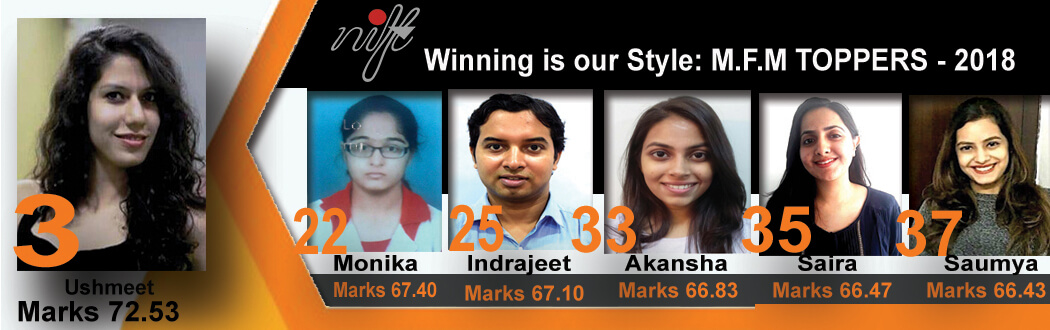
in General Category, Bhavya Diddee AIR 32, Marks 76.03 in General Category. In M.Des Palan Satsangi, AIR 2 with Marks 68.5 in OBC Category.Karan Tomar, AIR 29 in M.Ftech with Marks 60.78.

Master of Fashion Technology:

1) The scope of wearable smart gadgets in future.

2) Retailing artisans (weavers) with e-tailing sites. Will it help or not?

3) E- commerce – good or bad for apparel and handicraft industry in India?

4) Importance of eco- friendly products and techniques. New Zealand has developed a fabric from rice wastage. Should that be adopted by other countries too ( including India)?

5) Is cloud computing important in today’s industries? If yes then how does in help in reducing time and money?

6) Virtual stores – Will it take the society a step forward?

7) 3D printing – Will it be a boom in coming generation?

8) Should regenerated fibres be promoted in India? Will it harm the environment?


Master of Fashion Management

1) Do fairness products have the capability of tapping the Indian male market?

2) Average size models should be encouraged in promoting apparel or not?

3) Should Rayon be used over Cotton as an industrial fabric?

4) E-commerce vs Brick and mortar stores

5) Is discount the only lure for customers?

Here are some topics that might help you in preparation for group discussion

1) Should Indian textile industry focus more on the production of man-made fibers?

2) How will Startup India affect Indian Apparel Industry?

3) India- Market or producer for wearable technology?

4) Virtual Fitting Rooms – A changed shopping experience

5) Fashion revolution – A shift from aesthetics to functionality

6) Is Indian apparel industry a leader or follower in terms of technical advancement?

7) Natural fibers- endangering the natural resources. Do you agree or disagree?

8) Make In India is the biggest brand India has ever created. Discuss in the context of the textile industry.

9) Measures to promote Jute as the fashion fabric.

10) How is the collaboration of designers with e-commerce helping the garment business?

11) Should use of leather in fashion industry be completely banned?

12) How are ethical fashion shoppers influencing the garment manufacturing business?

13) Is following best social practices in the apparel industry as added expense?

14) Corporate Social Responsibility- A necessary evil. Do you agree or disagree?

15) Is current government support enough for the flourishing of Indian apparel industry?

16) How can technology be integrated with handicraft industry?

NIFT MFM GD PI TOPICS 2019

NIFT MFM GD-PI for year 2019 started from 3rd April and sharing some of the GD PI topics and questions which were asked.

Interview Questions:

1) I was asked to introduce myself and tell them about my background
They built questions from that itself 

2) They asked whether smartphones and the cameras in phones are diminishing the usage of DSLRs 

3) I was asked to compare twitter and Instagram as social mediums 

4) I was asked to explain why I’m interested in fashion. 

5) why I didn’t opt for fashion design was also asked 

6) I was also asked whether changing schools was a good thing or bad (my dad was in the army and I ended up changing 9 schools

GD Topics:

1. Sustainable fashion
2. Can artificial intelligence be creative?
3. We were asked about women entrepreneurs in India in the next 10 years.

A case study was shared and then we all were given a minute to share our thoughts before the group could do an open discussion.


Interview Questions:


1) why I don’t want to continue the stream I am doing my graduation in .


2) the brand of clothes I was wearing .


3) 5 retailers name and 5 shirt brands 


4) subjects of the course I am applying for 


5) where do I see myself in 5 years from now .
6) Family Background

For any further updates call 88-00-22-6864


NID has declared its first phase result of B.Des/GDPD on 20th march 2019.The first phase of exam was full of surprises for the students as the pattern was changed and emphasis was more given on creative part.The 30 marks aptitude and 70 marks creative section was complete opposite to the previous years papers of NID ,though the difficulty level of the paper was moderate .

As expected the changed exam pattern impacted the cut off of NID B.Des and this year cut off was lower in comparison to last few years. The DAT Mains Exam 2019 is scheduled on 14 & 15 May 2019 providing shortlisted aspirants good number of days to prepare for studio test.First time NID is conducting second phase exam at its four exam centre : NID Ahmedabad(631 seats), Bengaluru(325 seats), Vijayawada(270 seats) and Kurukshetra(270 seats).The DAT Mains exam centre will have to be selected by the candidates themselves ONLY.Allotment of DAT Mains exam centre will be on first cum fist serve basis.Candidates who fail to submit their exam centre preference, will be allotted by the system based on the number of seats available at the respective centre. NID 1st Phase exam has 30% weightage and while 2nd Phase has 70% weightage so 2nd Phase is crucial stage for selection of NID aspirants.

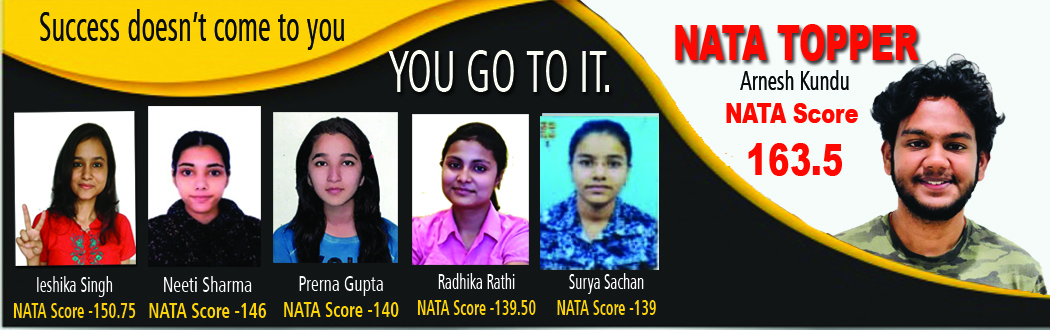
Again Pahal Design Students has performed extraordinary and more than 125 students qualified for NID B.Des/GDPD Mains exam.Top Scorer Tanvi with Score 69.5 out of 100 got AIR 9 in open category, Tarun got AIR 1 in ST category and Open Merit Rank 13 with Score 68.5, Palak with Score 65.5 and Open Merit Rank 28, Shubhanshu AIR 16 in ST Category with Score 56.5, Smridhi AIR 66, with Score 62.1, Sakshi Kumari AIR 72, with Score 61.5 and many more. Now Pahal Design has announced 20 Days Class for NID Mains Exam B.Des/GDPD at 30 Centres across India. Call 8800-22-6864 for more details or visit http://pahaldesign.com/nid-studio-test/

DRAWING QUESTIONS IN SHIFT 1:

 Q1. First question of the drawing section had three parts and students had to attempt any one of them for 30 marks. The questions were:

  • The first option was to design the curtain of a small girl’s room.
  • The second option was to sketch your favourite film actor.
  • The third option was to sketch the scene of people sitting around a bonfire.

Q2. In the second question of 20 marks students, a square design was given and students had to draw the same by drawing the replica to double its size.

Q3. For another and last question of the section of 20 marks was to draw a square with random designs using curved lines and colour.

DRAWING QUESTIONS IN SHIFT 2:

 Q1. Make a mirror image of a shape. This was a 20 marks question.

Q2. There were 3 options of 30 marks each. Candidates had to attempt any 1 of them:

  • Picture of your school
  • Image of your favourite actor
  • Male shirt using patterns and colours

Q3. The last question was of 20 marks too. In this the candidates had to make any unusual shape only using triangles.


DRAWING QUESTIONS IN SHIFT 1:

Q1. First question of the drawing section had three parts and students had to attempt any one of them for 30 marks. The questions were
• The first option was to design the curtain of a small girl’s room.
• The second option was to sketch your favourite film actor.
• The third option was to sketch the scene of people sitting around a bonfire.
Q2. In the second question of 20 marks students, a square design was given and students had to draw the same by drawing the replica to double its size.
Q3. For another and last question of the section of 20 marks was to draw a square with random designs using curved lines and colour.

DRAWING QUESTIONS IN SHIFT 2:

Q1. Make a mirror image of a shape. This was a 20 marks question.
Q2. There were 3 options of 30 marks each. Candidates had to attempt any 1 of them:
• Picture of your school
• Image of your favorite actor
• Male shirt using patterns and colors
Q3. The last question was of 20 marks too. In this the candidates had to make any unusual shape only using triangles.

JOIN NATA CRASH COURSE  2019 of 3 months / 2 months / 1 month at Pahal Design.

WhatsApp Enquiry