
The National Institute of Fashion Technology is a leader in fashion education with the ability to integrate knowledge, traditional arts, contemporary thought, academic freedom, innovations in design & technology and creative thinking to continuously upgrade its curriculum to address the changing needs of the industry. Its history of more than three decades at the pinnacle of fashion education stands as a testimony to its focus on core values where academic excellence has been nurtured. The institute has stood as a beacon of industry-academia engagement and a key enabler in developing competent professionals.

The National Institute of Fashion Technology (NIFT), set up in 1986 under the Ministry of Textiles, Government of India, is a Statutory Institute governed by the NIFT Act 2006. Bringing in a wide range of aesthetic & intellectual orientations, the early instructors included leading progressive scholars from Fashion Institute of Technology, New York, USA.

Academic inclusiveness has been the key thought in the expansion plans of the institute. NIFT, today, has spread its wings across the length and breadth of the country. Through its 16 professionally managed campuses, National Institute of Fashion Technology provides an excellent environment to its students from different parts of the country to achieve their highest potential through the programmes offered. Since the early years of its inception, the institute has provided a firm foundation in fashion education in the domains of Design, Management and Technology. Since then, NIFT has continued to set and achieve higher academic standards.

NIFT Courses:

  1. B.Des (Bachelor of Design)
  2. M.Des (Master of Design)
  3. B.Ftech (Bachelor of Fashion Technology)
  4. M.Ftech (Master of Fashion Technology)
  5. MFM (Master of Fashion Management)

NIFT Exam Pattern 2020: Creative Ability Test (CAT)

NIFT CAT exam pattern is such that candidates are evaluated on the basis of their intuition skill, power of observation, innovation in the development of a concept as well as design ability of the candidate. One of the most important aspects of NIFT CAT exam is that it tests the creative as well as innovative use of colour and illustration skills of aspirants.

NIFT CAT is a paper-pencil based exam and it is of three hours duration.

NIFT Exam Pattern 2020: General Ability Test (GAT)

Candidates seeking NIFT admissions in BDes programmes offered at NIFT need to appear for GAT exam. This test comprises of the below-mentioned sections:

    • Quantitative Ability
    • Communication Ability
  • English Comprehension
  • Analytical Ability
  • General Knowledge and Current Affairs

The duration of NIFT GAT is 120 minutes for BDes course. While formulating the merit list for BDes course admissions 30% weighatge is allotted to GAT section of NIFT entrance exam.

NIFT CAT Exam Pattern for BDes Admissions

In NIFT exam pattern 2020 for BDes admissions, candidates need to appear for CAT. NIFT CAT exam paper has three questions which candidates need to attempt in three hours duration. In this design entrance exam, candidates are evaluated on the below mentioned parameters:

  • Design ability
  • Intuitive ability
  • Observation skills
  • Concept development skills
  • Creative use of colour
  • Illustration skills

NIFT Exam Pattern for Situation Test
Candidates who have been shortlisted for NIFT BDes admissions on the basis of their written test need to appear for NIFT Situation Test 2020 wherein their “material handling and innovative ability” will be tested.

Here, candidates will be evaluated on “on Space Visualization, Innovative and creative use of given material, composition of elements, colour scheme, construction skill , finesse of the model and overall presentation etc. These parameters will be checked with the write up explaining the concept / idea behind the model constructed. The weightage of the write up is 30%. Since the medium of teaching in NIFT is English, the write-up will be in English language.

  1. What is the marking scheme for NIFT entrance exam? NIFT exam marking scheme varies for CAT and GAT. In NIFT CAT exam, candidates are evaluated out of 100 marks. In GAT exam, aspirants are awarded for one mark for every correct answer and 0.25 marks are deducted for each wrong answer selected by them.
  2. How can I prepare for NIFT CAT? Candidates need to go through the detailed exam pattern as well as syllabus for NIFT CAT and thereafter formulate a preparation strategy. In NIFT CAT exam, aspirants are evaluated on the basis of their power of observation, innovation and design ability. Candidates can go through NIFT Entrance Exam Preparation to have a plan in place when preparing for this design entrance exam.
  3. How can I prepare for NIFT GAT? NIFT GAT comprises of multiple choice questions that aspirants need to solve in order to crack the exam. Questions in NIFT GAT are from subjects such as Quantitative Ability, Communication Ability, English Comprehension, Analytical Ability, General Knowledge and Current Affairs.
  4. Is there any negative marking in NIFT entrance exam? There is no negative marking in NIFT CAT exam. However, for GAT exam, 0.25 marks will be deducted for each wrong answer selected by a candidate. 
  5. What is the syllabus for NIFT exam? National Institute of Fashion Technology does not release any syllabus for NIFT exam. However, candidates can develop an idea of NIFT Entrance Exam Pattern.
  6. How many questions are asked in NIFT CAT? In NIFT CAT, candidates have to attempt three drawing questions.
  7. How many questions are asked in NIFT GAT? The exam pattern for NIFT GAT varies from one course to the other. The total number of questions asked in NIFT GAT are mentioned below:
  • BDes: 100 questions
  • BFTech: 150 questions
  • MDes: 120 questions
  • MFTech: 150 questions
  • MFM: 150 questions

Pahal Design Gwalior

D/2, Ground Floor, Basant Vihar Colony, Gwalior

Contact Person: Kanika Jain

Mobile Number: 93540-52529

Email : corporate@pahaldesign.com

ngg_shortcode_5_placeholder 
 

The National Institute of Fashion Technology is a leader in fashion education with the ability to integrate knowledge, traditional arts, contemporary thought, academic freedom, innovations in design & technology and creative thinking to continuously upgrade its curriculum to address the changing needs of the industry. Its history of more than three decades at the pinnacle of fashion education stands as a testimony to its focus on core values where academic excellence has been nurtured. The institute has stood as a beacon of industry-academia engagement and a key enabler in developing competent professionals.

The National Institute of Fashion Technology (NIFT), set up in 1986 under the Ministry of Textiles, Government of India, is a Statutory Institute governed by the NIFT Act 2006. Bringing in a wide range of aesthetic & intellectual orientations, the early instructors included leading progressive scholars from Fashion Institute of Technology, New York, USA.

Academic inclusiveness has been the key thought in the expansion plans of the institute. NIFT, today, has spread its wings across the length and breadth of the country. Through its 16 professionally managed campuses, National Institute of Fashion Technology provides an excellent environment to its students from different parts of the country to achieve their highest potential through the programmes offered. Since the early years of its inception, the institute has provided a firm foundation in fashion education in the domains of Design, Management and Technology. Since then, NIFT has continued to set and achieve higher academic standards.

NIFT Courses:

  1. B.Des (Bachelor of Design)
  2. M.Des (Master of Design)
  3. B.Ftech (Bachelor of Fashion Technology)
  4. M.Ftech (Master of Fashion Technology)
  5. MFM (Master of Fashion Management)

NIFT Exam Pattern 2020: Creative Ability Test (CAT)

NIFT CAT exam pattern is such that candidates are evaluated on the basis of their intuition skill, power of observation, innovation in the development of a concept as well as design ability of the candidate. One of the most important aspects of NIFT CAT exam is that it tests the creative as well as innovative use of colour and illustration skills of aspirants.

NIFT CAT is a paper-pencil based exam and it is of three hours duration.
NIFT Exam Pattern 2020: General Ability Test (GAT)

Candidates seeking NIFT admissions in BDes programmes offered at NIFT need to appear for GAT exam. This test comprises of the below-mentioned sections:

  • Quantitative Ability
  • Communication Ability
  • English Comprehension
  • Analytical Ability
  • General Knowledge and Current Affairs

The duration of NIFT GAT is 120 minutes for BDes course. While formulating the merit list for BDes course admissions 30% weighatge is allotted to GAT section of NIFT entrance exam.

NIFT CAT Exam Pattern for BDes Admissions

In NIFT exam pattern 2020 for BDes admissions, candidates need to appear for CAT. NIFT CAT exam paper has three questions which candidates need to attempt in three hours duration. In this design entrance exam, candidates are evaluated on the below mentioned parameters:

  • Design ability
  • Intuitive ability
  • Observation skills
  • Concept development skills
  • Creative use of colour
  • Illustration skills

NIFT Exam Pattern for Situation Test 

Candidates who have been shortlisted for NIFT BDes admissions on the basis of their written test need to appear for NIFT Situation Test 2020 wherein their “material handling and innovative ability” will be tested.

Here, candidates will be evaluated on “on Space Visualization, Innovative and creative use of given material, composition of elements, colour scheme, construction skill , finesse of the model and overall presentation etc. These parameters will be checked with the write up explaining the concept / idea behind the model constructed. The weightage of the write up is 30%. Since the medium of teaching in NIFT is English, the write-up will be in English language.

  1. What is the marking scheme for NIFT entrance exam? NIFT exam marking scheme varies for CAT and GAT. In NIFT CAT exam, candidates are evaluated out of 100 marks. In GAT exam, aspirants are awarded for one mark for every correct answer and 0.25 marks are deducted for each wrong answer selected by them.
  2. How can I prepare for NIFT CAT? Candidates need to go through the detailed exam pattern as well as syllabus for NIFT CAT and thereafter formulate a preparation strategy. In NIFT CAT exam, aspirants are evaluated on the basis of their power of observation, innovation and design ability. Candidates can go through NIFT entrance exam preparationto have a plan in place when preparing for this design entrance exam.
  3. How can I prepare for NIFT GAT? NIFT GAT comprises of multiple choice questions that aspirants need to solve in order to crack the exam. Questions in NIFT GAT are from subjects such as Quantitative Ability, Communication Ability, English Comprehension, Analytical Ability, General Knowledge and Current Affairs.
  4. Is there any negative marking in NIFT entrance exam? There is no negative marking in NIFT CAT exam. However, for GAT exam, 0.25 marks will be deducted for each wrong answer selected by a candidate.
  5. What is the syllabus for NIFT exam? National Institute of Fashion Technology does not release any syllabus for NIFT exam. However, candidates can develop an idea of NIFT entrance exam syllabus here.
  6. How many questions are asked in NIFT CAT? In NIFT CAT, candidates have to attempt three drawing questions.
  7. How many questions are asked in NIFT GAT? The exam pattern for NIFT GAT varies from one course to the other. The total number of questions asked in NIFT GAT are mentioned below:
  • BDes: 100 questions
  • BFTech: 150 questions
  • MDes: 120 questions
  • MFTech: 150 questions
  • MFM: 150 questions

Pahal Design Lucknow Centres:

Lucknow (Hazratganj)

Address:- 77, 1st Floor, Halwasiya Market, Hazratganj, Lucknow – 226001
Contact No : 0522-4077691, 964848-4145
Contact Person : Mr. Abad Ali
Email : lucknow@pahaldesign.com

Lucknow (Aliganj)

Address:- HIG 7 Sector E, Above Kidzee School, Opposite Radhe Lal Sweets, Aliganj, Lucknow – 226024
Contact No : 0522-4240662, 9415-999-864 / 65
Contact Person : Mr. Waris
Email : aliganj@pahaldesign.com

Lucknow (Gomti Nagar)

Contact No : 0522-4240662, 9415-999-864 / 65
Contact Person : Mr. Waris
Email : lucknow@pahaldesign.com

The National Institute of Fashion Technology is a leader in fashion education with the ability to integrate knowledge, traditional arts, contemporary thought, academic freedom, innovations in design & technology and creative thinking to continuously upgrade its curriculum to address the changing needs of the industry. Its history of more than three decades at the pinnacle of fashion education stands as a testimony to its focus on core values where academic excellence has been nurtured. The institute has stood as a beacon of industry-academia engagement and a key enabler in developing competent professionals.

The National Institute of Fashion Technology (NIFT), set up in 1986 under the Ministry of Textiles, Government of India, is a Statutory Institute governed by the NIFT Act 2006. Bringing in a wide range of aesthetic & intellectual orientations, the early instructors included leading progressive scholars from Fashion Institute of Technology, New York, USA.

Academic inclusiveness has been the key thought in the expansion plans of the institute. NIFT, today, has spread its wings across the length and breadth of the country. Through its 16 professionally managed campuses, National Institute of Fashion Technology provides an excellent environment to its students from different parts of the country to achieve their highest potential through the programmes offered. Since the early years of its inception, the institute has provided a firm foundation in fashion education in the domains of Design, Management and Technology. Since then, NIFT has continued to set and achieve higher academic standards.

NIFT Courses:

  1. B.Des (Bachelor of Design)
  2. M.Des (Master of Design)
  3. B.Ftech (Bachelor of Fashion Technology)
  4. M.Ftech (Master of Fashion Technology)
  5. MFM (Master of Fashion Management)

NIFT Exam Pattern 2020: Creative Ability Test (CAT)

NIFT CAT exam pattern is such that candidates are evaluated on the basis of their intuition skill, power of observation, innovation in the development of a concept as well as design ability of the candidate. One of the most important aspects of NIFT CAT exam is that it tests the creative as well as innovative use of colour and illustration skills of aspirants.

NIFT CAT is a paper-pencil based exam and it is of three hours duration.

NIFT Exam Pattern 2020: General Ability Test (GAT)

Candidates seeking NIFT admissions in BDes programmes offered at NIFT need to appear for GAT exam. This test comprises of the below-mentioned sections:

  • Quantitative Ability
  • Communication Ability
  • English Comprehension
  • Analytical Ability
  • General Knowledge and Current Affairs

The duration of NIFT GAT is 120 minutes for BDes course. While formulating the merit list for BDes course admissions 30% weighatge is allotted to GAT section of NIFT entrance exam.

NIFT CAT Exam Pattern for BDes Admissions

In NIFT exam pattern 2020 for BDes admissions, candidates need to appear for CAT. NIFT CAT exam paper has three questions which candidates need to attempt in three hours duration. In this design entrance exam, candidates are evaluated on the below mentioned parameters:

  • Design ability
  • Intuitive ability
  • Observation skills
  • Concept development skills
  • Creative use of colour
  • Illustration skills

NIFT Exam Pattern for Situation Test

Candidates who have been shortlisted for NIFT BDes admissions on the basis of their written test need to appear for NIFT Situation Test 2020 wherein their “material handling and innovative ability” will be tested.

Here, candidates will be evaluated on “on Space Visualization, Innovative and creative use of given material, composition of elements, colour scheme, construction skill , finesse of the model and overall presentation etc. These parameters will be checked with the write up explaining the concept / idea behind the model constructed. The weightage of the write up is 30%. Since the medium of teaching in NIFT is English, the write-up will be in English language.

  1. What is the marking scheme for NIFT entrance exam? NIFT exam marking scheme varies for CAT and GAT. In NIFT CAT exam, candidates are evaluated out of 100 marks. In GAT exam, aspirants are awarded for one mark for every correct answer and 0.25 marks are deducted for each wrong answer selected by them.
  2. How can I prepare for NIFT CAT? Candidates need to go through the detailed exam pattern as well as syllabus for NIFT CAT and thereafter formulate a preparation strategy. In NIFT CAT exam, aspirants are evaluated on the basis of their power of observation, innovation and design ability. Candidates can go through NIFT entrance exam preparation to have a plan in place when preparing for this design entrance exam.
  3. How can I prepare for NIFT GAT? NIFT GAT comprises of multiple choice questions that aspirants need to solve in order to crack the exam. Questions in NIFT GAT are from subjects such as Quantitative Ability, Communication Ability, English Comprehension, Analytical Ability, General Knowledge and Current Affairs.
  4. Is there any negative marking in NIFT entrance exam? There is no negative marking in NIFT CAT exam. However, for GAT exam, 0.25 marks will be deducted for each wrong answer selected by a candidate. 
  5. What is the syllabus for NIFT exam? National Institute of Fashion Technology does not release any syllabus for NIFT exam. However, candidates can develop an idea of NIFT entrance exam syllabus here.
  6. How many questions are asked in NIFT CAT? In NIFT CAT, candidates have to attempt three drawing questions.
  7. How many questions are asked in NIFT GAT? The exam pattern for NIFT GAT varies from one course to the other. The total number of questions asked in NIFT GAT are mentioned below:
  • BDes: 100 questions
  • BFTech: 150 questions
  • MDes: 120 questions
  • MFTech: 150 questions
  • MFM: 150 questions

Pahal Design Gwalior

D/2, Ground Floor, Basant Vihar Colony, Gwalior

Contact Person: Kanika Jain

Mobile Number: 93540-52529

Email : corporate@pahaldesign.com

ngg_shortcode_6_placeholder 


NATA measures the aptitude of the applicant for specific field of study, i.e. Architecture. The test makes an assessment of drawing and observation skills, sense of proportion, aesthetic sensitivity, Physics, Chemistry and Mathematics at 10+2 level and critical thinking ability that have been acquired by the candidate over the past few years and are related to the specific field of study.
With the objective of attracting a greater number of bright aspirants for studying Architecture and practicing the same as a profession in future, CoA like every year will be conducting NATA-2020 for admission to B.Arch. in the academic session 2020-2021. NATA-2020 shall be conducted twice a year, thus giving opportunity to those students who miss out the first test due to some reason or other or wish to improve upon their NATA score in the first test by re-appearing the second test. Both the first and second test will be conducted on a different date as a one-day online examination all over the country. The test shall consist of two parts: Part A is on Drawing, which is paper based and Part B comprises of Multiple Choice Questions (MCQ)on Physics, Chemistry, Mathematics and general aptitude which is to be answered online.

NATA 2020 is a qualifying aptitude test for admission into the B. Arch degree program, subject to fulfillment of eligibility criteria prescribed by the Council. The candidates who have passed 10+2 level examination with at least 50% aggregate marks in Physics, Chemistry & Mathematics (PCM) and also at least 50% marks in aggregate of the 10+2 level examination or passed 10+3 Diploma Examination with Mathematics as compulsory subject with at least 50% marks in aggregate, shall be eligible to appear for NATA-2020.

The candidates appearing for 10+2 examination with PCM or 10+3 Diploma with Mathematics in the current year may also provisionally appear for NATA-2020, subject to fulfilling the above criteria.

The candidates belonging to SC, ST, OBC-NCL category or PwD (Persons with disability) shall be provided a relaxation of 5% marks in total aggregate in 10+2 level/10+3 Diploma as well as PCM.

Pahal Design Preet Vihar

Address:- C-57, Second Floor, Preet Vihar, Vikas Marg, Metro Pillar No-81.
(Near by Metro – Nirman Vihar / Preet Vihar ), New Delhi – 110092
Contact No : 011-45142542, 88264-92570, 93540-52529
Contact Person : Ms. Kanika Jain
Email : delhi@pahaldesign.com


National Institute of Design (NID) at Ahmedabad and at its Bengaluru and Gandhinagar Extension campuses is an ‘Institute of National Importance’ as per the NID Act 2014 as well as an autonomous Institute under the Department for Promotion of Industry and Internal Trade (DPIIT), Ministry of Commerce & Industry, Government of India. As per the NID Act 2014, the Institute is a statutory authority empowered to award its own degrees— presently offering Bachelor of Design (B.Des.) of four-year duration, Masters of Design (M.Des.) of two-and-a-half year duration and PhD in Design. The Institute is also a member of the Association of Indian Universities (AIU).

NID Andhra Pradesh, NID Haryana, NID Madhya Pradesh & NID Assam are independent autonomous institutes under the DPIIT, Ministry of Commerce & Industry, Government of India and offer full time Graduate Diploma Programme in Design (GDPD) of four-year duration.

Admission to all the programmes at NID is on the basis of the candidates’ performance in the two-stages of Design Aptitude Test. The objective of these exams is to assess the knowledge, skills and behavioural abilities of candidates.

Stage 1: Design Aptitude Test (DAT) Prelims

Design Aptitude Test (DAT) Prelims will be conducted at various test centres across India (Refer Section 7.3 of this document). Candidates should note that appearing for the DAT Prelims or being shortlisted for second stage of admission process does NOT guarantee automatic entitlement to admission.

Stage 2: Design Aptitude Test (DAT) Mains

Candidates shortlisted after the DAT Prelims will be invited to appear for the Stage 2 DAT Main exam at Ahmedabad or at all campuses of NID viz Ahmedabad, Bengaluru, Gandhinagar, Haryana, Andhra Pradesh, Assam and Madhya Pradesh. Exact details of the Test Centre will be mentioned in the DAT Mains Admit Card.

Note:

  • Candidates are fully and solely responsible to provide correct information during the application process. If it is found that any information provided by the candidate is not true, NID has the right to cancel, at any stage, the candidate’s application or admission in accordance with its rules and regulations. Any direct or indirect attempt to influence the management and employees of the Institute will lead to automatic disqualification of the candidate.
  • The Institute has the sole prerogative to determine the procedure for each cycle of admission. In case of any matter not covered in this handbook, NID’s decisions shall be considered final and binding to all the parties concerned.
Pahal Design Preet Vihar

Address:- C-57, Second Floor, Preet Vihar, Vikas Marg, Metro Pillar No-81.
(Near by Metro – Nirman Vihar / Preet Vihar ), New Delhi – 110092
Contact No : 011-45142542, 88264-92570, 93540-52529
Contact Person : Ms. Kanika Jain
Email : delhi@pahaldesign.com

  1. Foundation Batch – 2 Years
  2. Regular Weekdays Batch
  3. Regular Weekend Batch
  4. Crash Course Batch
  5. Studio Test 
  6. Portfolio Preparation

NIFT is a Premier Institute of Design Management and Technology in the Fashion Business in India and is recognised worldwide. Our academic practices continue to lead infinite possibilities into the future, solving design challenges on our way. NIFT provides a unique environment for nurturing the creative talent in the field of design and other associated fields in fashion.The National Institute of Fashion Technology (NIFT), set up in 1986 under the Ministry of Textiles, Government of India, is a Statutory Institute governed by the NIFT Act 2006. Bringing in a wide range of aesthetic & intellectual orientations, the early instructors included leading progressive scholars from Fashion Institute of Technology, New York, USA. NIFT is committed to academic excellence in fashion education. The vision of the institute embraces challenges and provides the impetus in setting highest academic standards. NIFT continues to strive to be nothing but the best.

The revised curriculum structure of NIFT arrived through deliberations, workshops and interactions involving internal
experts and eminent academicians, industrialists and NIFT Alumni envisaged the necessity and importance of Industry engagement through:
• Interaction with Industry leaders and alumni in the classroom • Sponsored classroom projects
• Industry visits
• Exposure to exhibitions and fairs
• Internships
• Joint research endeavours
• Hands-on practical learning experience in industry environment to be transacted within the curriculum structure.

The academic strategy of NIFT embraces internationalism. Over the years, NIFT has consciously enhanced its international visibility and standing among other reputed fashion institutes abroad. NIFT has strategic agreements and partnerships with 26 leading international fashion institutes & organizations that share the same academic direction. On one hand this gives NIFT students a unique opportunity to integrate with the global mainstream of fashion by opting for the exchange program with collaborating partner institutes and on the other, presents the international students with plethora of similar ‘study abroad’ options under exchange programs at NIFT.

Pahal Design Preet Vihar

Preet Vihar

Address:- F-16, 1st Floor, Preet Vihar, 
(Nearby Metro – Preet Vihar, Lift No 3 ), New Delhi – 110092
Contact No: 93540-52529
Contact Person: Mr. Prashant Verma
Email: corporate@pahaldesign.com

ngg_shortcode_7_placeholder

  1. Foundation Batch – 2 Years
  2. Regular Weekend Batch
  3. Regular Weekdays Batch
  4. Crash Course Batch
  5. Situation test Batch
  6. GD / PI Batch


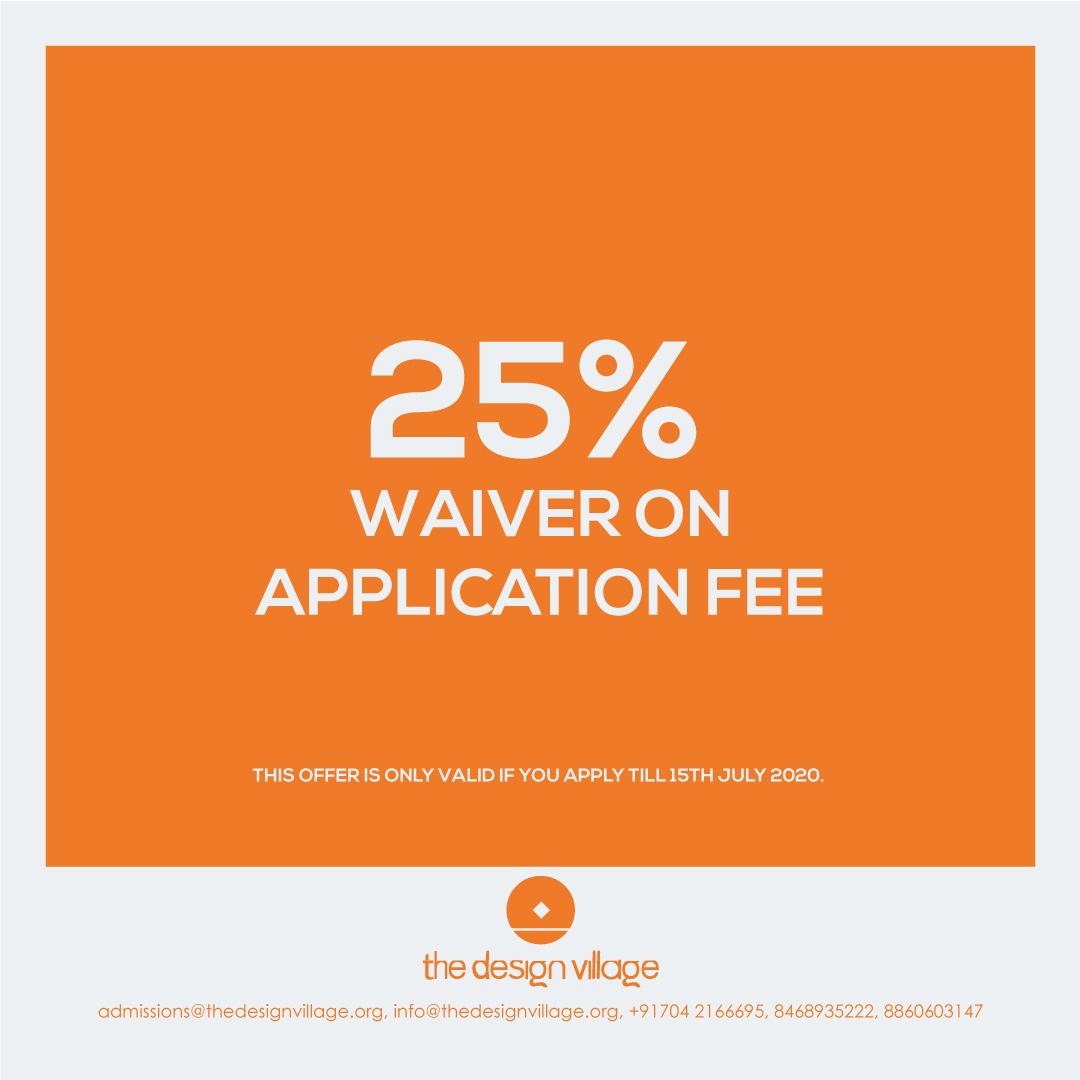
Due to the current COVID-19 setback, we would like to offer a 25% waiver on our application fees for all the design aspirants who wish to appear in the TDV online entrance exam scheduled on 19 July 2020.

This offer is only valid if you apply till 15th July 2020.

Move a step closer towards realising your design dream. Additionally, upto 100% scholarship available on tuition fees.
To apply, please visit: http://bit.ly/2XrSJw6

In case of any queries, feel free to contact us at 8800-22-6864

congratulations #uceed #2020 #toppers #iit #jabalpur #bdes #bdesign All the Best Darpan Hans for being selected for the B Des Programme in IIITDM Jabalpur

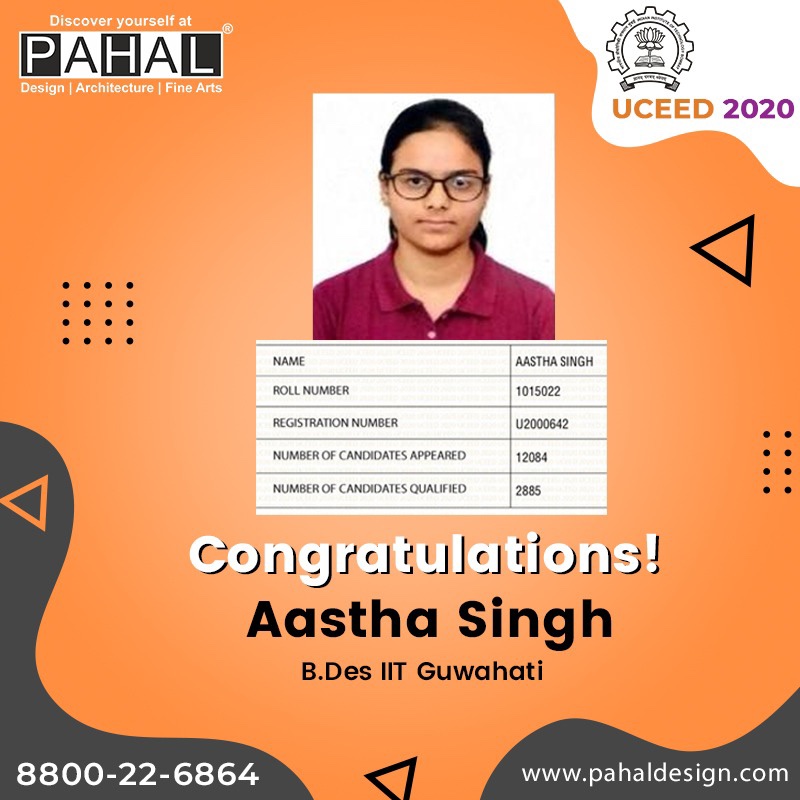
congratulations #uceed #2020 #toppers #iit #guwahati #bdes #bdesign All the Best Aastha Singh for being selected for the B Des Programme in IIT Guwahati

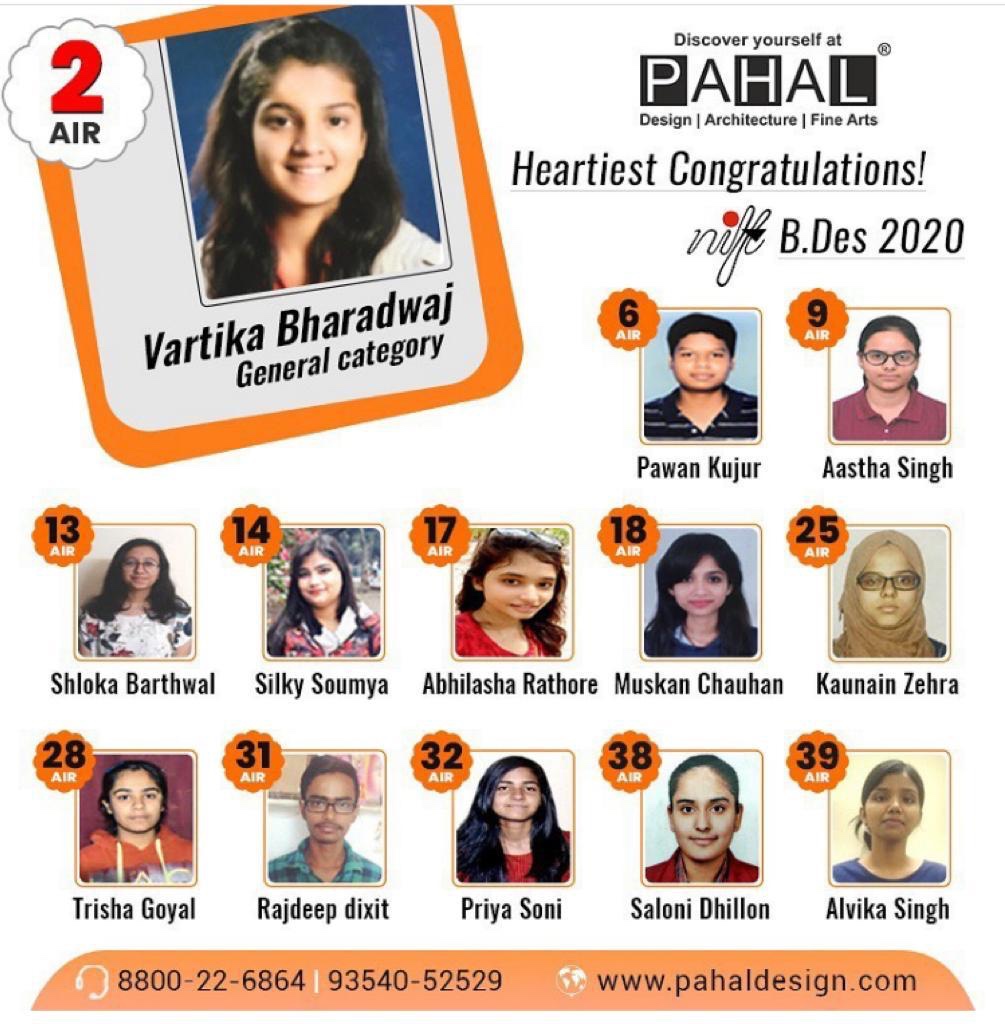
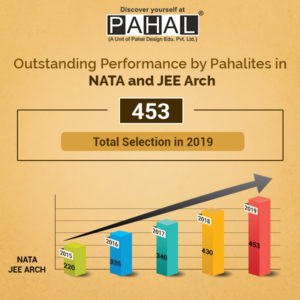
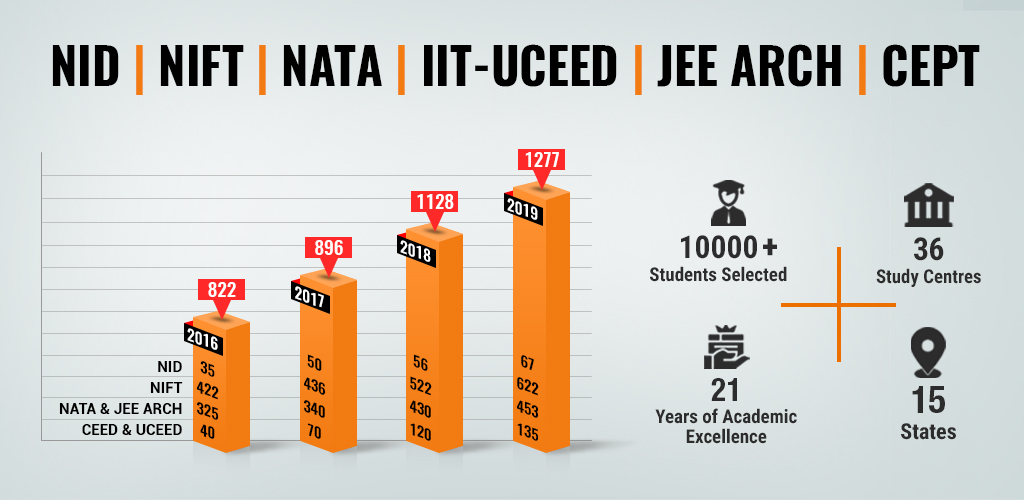
nift #bdesign #toppers #2020 #congratulations Yet another proof of Leadership in year 2020. More than 500 students are being selected for NIFT B. Design 2020 and still counting….23 students are in NIFT Top 50 from different categories. 44 students in NIFT Top 100.

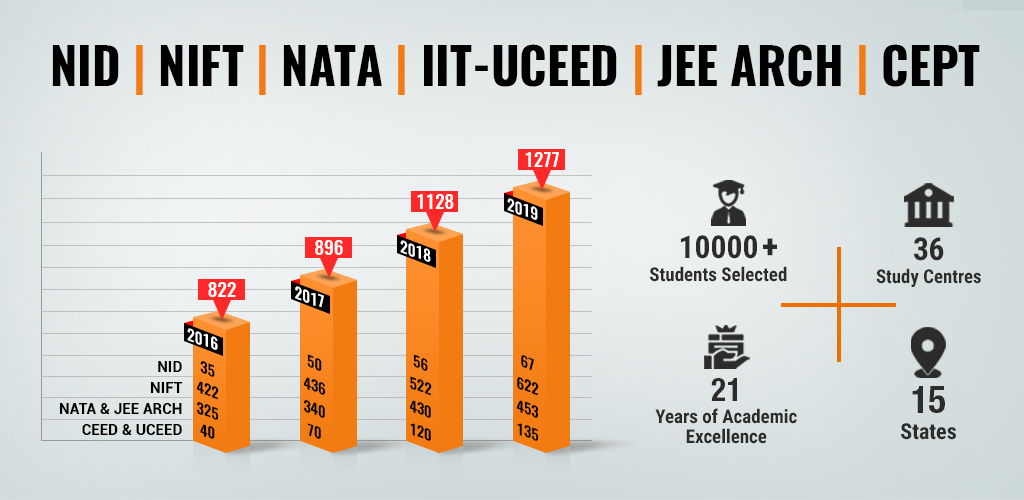
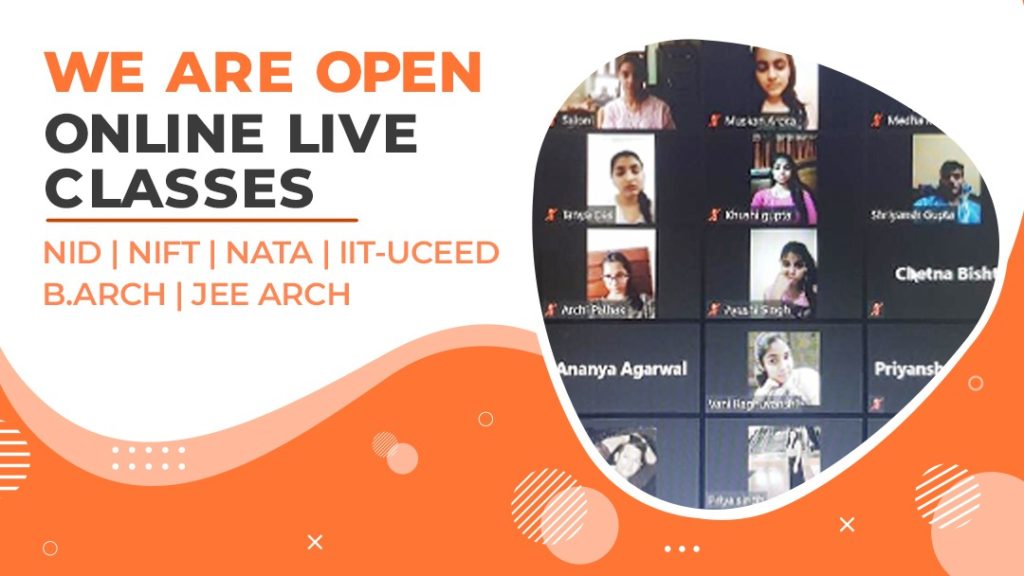
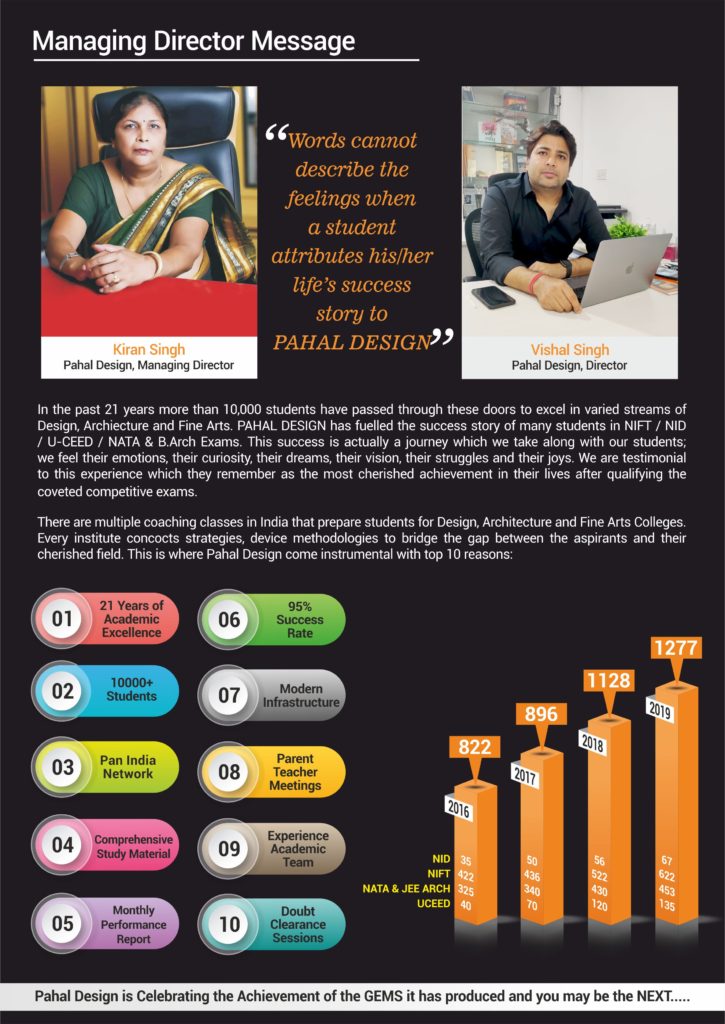
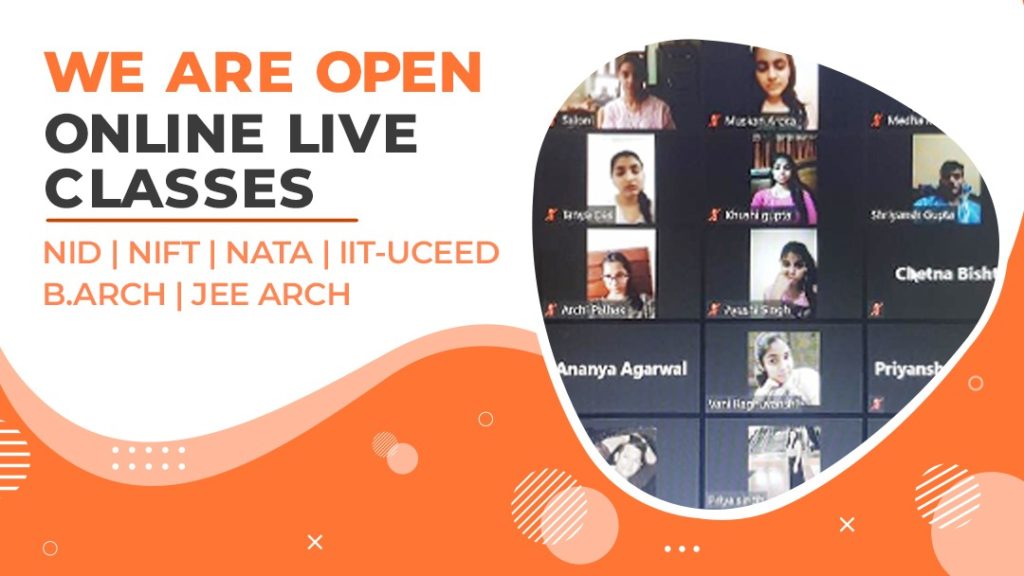
PahalDesign Education Private Ltd. comes up with its Online platform called Pahal Live. Pahal Design is the Original Pioneer in conducting coaching classes for NID, NIFT, NATA, UCEED, CEED, JEE ARCH, Fine Arts, BFA, MFAand Portfolio Preparation for Overseas and Private Colleges. These Online classes can be attended live from the comfort of your home. The program is delivered through a series of pre-scheduled live and recorded online lectures and has extensive course coverage. The objective behind these classes is to provide a real classroom experience at your home and time, thus allowing the students to raise any doubts or queries and have them answered instantly by our expert mentor. Even if you get further any doubt after live session, you may get them answered from the faculty or expert via the dedicated Telegram/WhatsApp group of your batch. 

Top 10 Reasons Why You Should Join Pahal Live?

1. 21 Years of Academic excellence
2. Experienced Faculty from NID, IDC, NIFT, SPA, DCA, J J College, CEPT
3. Doubt Clearing Sessions
4. Weekly Feedback
5. Live Interactive Classes
6. Recorded Video Lectures
7. Study Material
8. Study Online at Home
9. Replay a missed class
10.Mock Test Analysis and Report

Guru Purnima is one of the most important festivals in the nation. People celebrated it irrespective of caste or creed because in this country, the most important thing was not wealth or money. Knowledge or knowing was considered the highest value. A teacher or guru was considered the highest entity in society because knowing is the most important thing.

WhatsApp Enquiry